

State and Local Education Funding
Updated: Oct 29
In Why US Federal Laws do not address educational inequality, I noted that "...federal grants typically cover only 8% to 10% of K–12 public school budgets, leaving the remaining 90% dependent on state and local revenues." so how much do states contribute to education?
Public school funding is largely decentralized in the U.S. While states contribute an average of ~45% of education budgets, reliance varies dramatically from state-level tax equalization models to local property tax reliance.
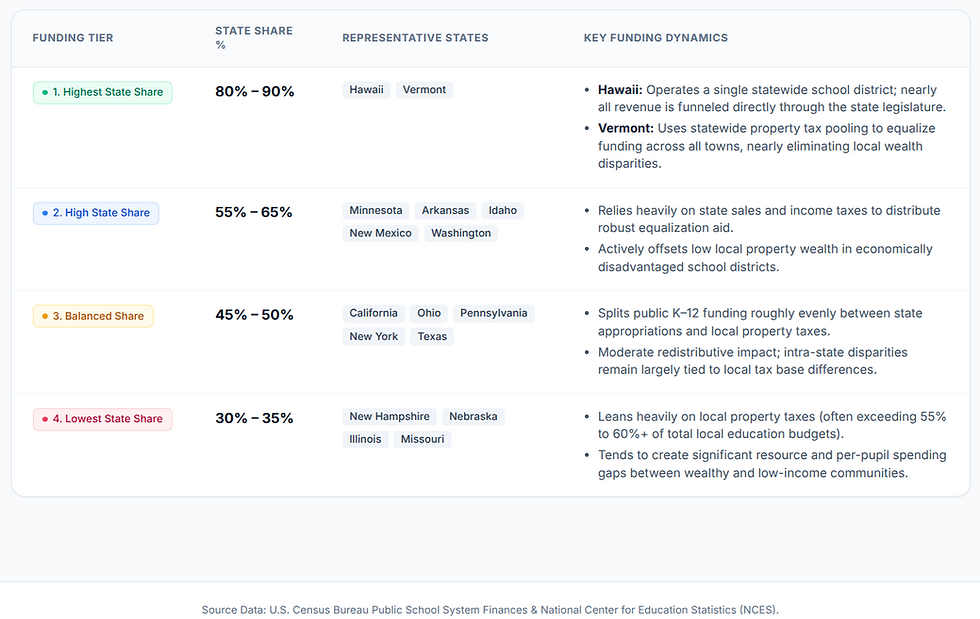
As for local funding, property taxes are the biggest source (80%-85%) of local sources of school funding. Property taxes rely on local real estate values so school districts in high-property-value areas raise significantly more money per student than districts in low-property-value areas, even if residents in lower-wealth areas pay a higher tax rate.
Further, affluent communities raise exponentially more money through Parent-Teacher Associations (PTAs), Parent-Teacher Organizations (PTOs), and localized educational foundations than low-income communities. In Illinois, over 50% of all school-based fundraising groups in the U.S. serve schools located in the wealthiest 25% of neighborhoods. (Source: Urban Institute) And in San Francisco, California, PTAs at affluent public schools frequently raise between $500 to over $1,500 per student annually. In contrast, PTAs at high-poverty schools often struggle to raise $10 to $30 per student—or have no active PTA at all due to a lack of volunteer bandwidth. (Source: San Francisco Public Press)
Find out who your state's representatives are here and find out what they support. Let them know that educational equity is important to you.

Comments