

Why US Federal Laws do not address educational inequality
Updated: Oct 29
Despite federal legislation like Title I of the Every Student Succeeds Act (ESSA) designed to support economically disadvantaged students, significant resource gaps persist across U.S. K–12 public schools. A primary structural reason is the federal government’s limited financial footprint: federal grants typically cover only 8% to 10% of K–12 public school budgets, leaving the remaining 90% dependent on state and local revenues.
Because local funding heavily relies on local property taxes, wealthy districts with strong tax bases routinely generate far greater revenue per pupil than low-income districts. Furthermore, as highlighted in UCLA School Mental Health Project research on inequitable funding, money alone does not translate into equal outcomes when poorer districts face higher baseline demands—such as specialized support for English Language Learners, special education, and trauma-informed care—that dilute the purchasing power of their academic budgets.
Consequently, low-income schools often suffer from a compounding cycle of underfunding that manifests as larger class sizes, non-competitive teacher wages, high staff turnover, and outdated instructional materials. Private parent-teacher fundraising and local foundations in affluent neighborhoods further widen the resource gulf by privately subsidizing advanced STEM labs, arts programs, and extracurricular activities that federal formulas cannot regulate.
While federal intervention serves as a critical safety net, federal dollars function as a supplemental cushion rather than a replacement for systemic reform of state and local tax-based funding models.
While Federal dollars make up a small percent, every dollar means less needed at the state and local level so find your state's US Congress Senators and Representatives here and let them know you want them to support educational equity.
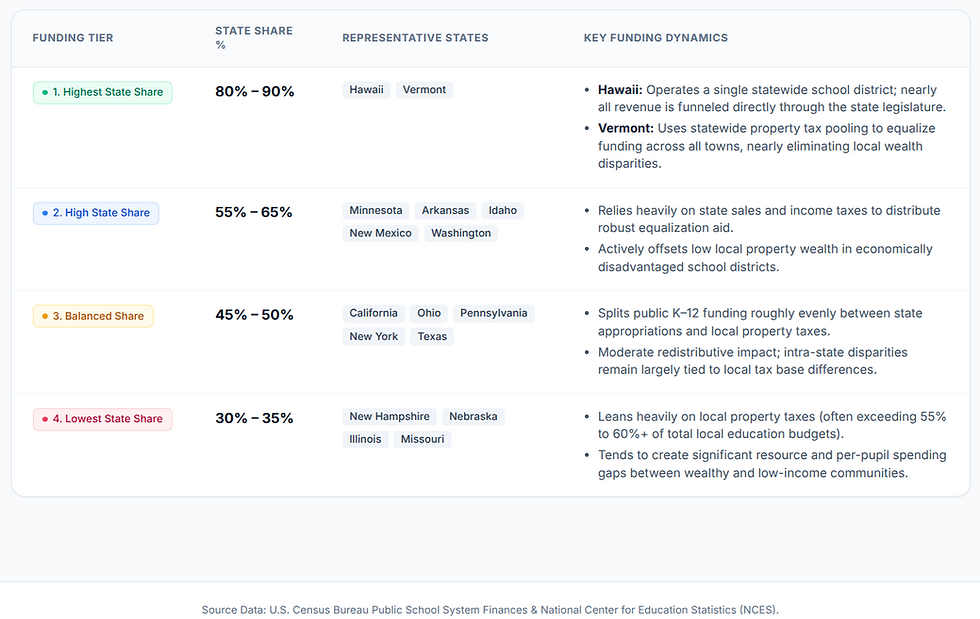
To make a bigger impact one has to learn more about the funding sources at the state and local level in order to understand the dynamics impacting educational inequalities.

Comments